The best strategy for Speaking Part 3
As mentioned above, Speaking Part 3 has two sections and for each one you should follow a different plan. Luckily, this plan can be used every time you practise as well as in the exam itself, so let’s see what Teacher Phill’s got for you.
Section 1
In the discussion part you should mostly focus on
well structured answers,
good language and
interaction with your partner.
It follows a cycle that you go through together until the examiner stops you after about two minutes. This cycle looks something like this:
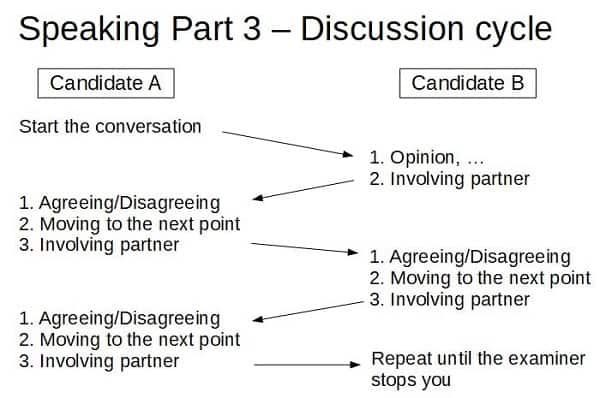
You can see that it is a back and forth between you and your partner and it always follows the same structure. You agree or disagree, you give your opinion (always give reasons and examples to support your argument) and you invite the other candidate back into the conversation. You do this until the two minutes are up and the examiner asks you to stop.
Later in this article we are going to look at two real video examples to see how this works in practice so keep reading.
Section 2
The second section of Speaking Part 3 is different from the first one in a couple of ways. Number one, you have only one minute and number two, you have to decide something with your partner instead of discussing the question in the spiderweb. It is very important for you to have the right strategy in order to balance your talking time and to work towards a decision.
Just as before, however, there is a model that you can and should use:
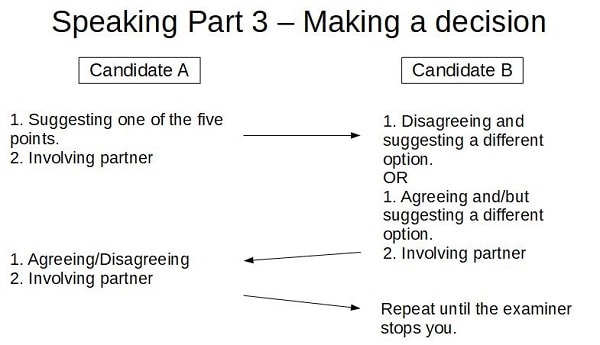
It always works the same. Candidate A starts by suggesting one of the five prompts giving reasons for his/her answer. The next step is the most important part. Candidate B has to suggest another option because if you simply agree, there won’t be anything left to talk about. The problem is that you need to speak until the examiner stops you.
For this reason, Candidate B always offers another option so that you can choose between two of the points. This way, you can talk to each other for the full minute using some nice language (keep reading below for good examples) and interacting with each other.
If this sounds very complicated, don’t worry because as I said earlier, we are going to check out two real-life examples later in this article so you can see exactly how it works.
Don’t make these mistakes
Even though this might sound very straightforward, there are some very typical mistakes that candidates make and I want to show you how to avoid them. If you want to know more about other common mistakes in Part 2 of the FCE Speaking exam, you can read my other article right here in which I tell you exactly what many people do wrong and how you can it better. Here we are only going to focus on Speaking Part 3 so jump over to my other post to get even more great tips.
1. Useful language really helps
Teachers like me always try to get their students to use some specific language. It really helps you to stay on task instead of talking about unrelated things and because examiners look for these expressions you can also score good marks if you put some of them in your test.
In Speaking Part 3, we can put our useful phrases in three different groups: giving your opinion, agreeing/disagreeing and inviting your partner to speak. Let’s have a look at some examples.
| Giving your opinion |
| I think … I think a large nightclub could definitely bring more tourists to a town, especially people who want to visit just for a day. I believe … More security cameras make people feel safe so I believe it can be a good idea to attract more tourists. I feel … I feel that more shops, and especially designer shops, can attract wealthier tourists who are willing to spend more money. In my opinion, … Providing parks, in my opinion, is a very good way to please people living in a town, but I’m not sure how it can help increase the number of tourists. I would say … I would say that if you build new modern holiday flats, it can definitely attract new tourists to your town. From my point of view / In my view, … In my view, more shops can attract more tourists. From my perspective, … From my perspective, the added security because of more cameras can bring more tourists to the town. It seems to me that … It seems to me that a large nightclub can improve the offers a town can make to potential tourists. |
| Agreeing |
| A: I think nightclubs are a great way to attract tourists B: So do I. OR Me too. OR Definitely. OR I couldn’t agree more. OR I agree. OR I see your point. |
| Disagreeing |
| A: In my opinion, modern accommodation is definitely a good reason for tourists to choose one destination over another. B: I disagree. OR I’m not sure if I can agree with you. OR Yeah, but … OR I’m sorry, but I don’t agree. OR I’m afraid I disagree. OR I see what you’re trying to say, but … OR I understand where you’re coming from, but … |
Be careful because we never say “I am agree/disagree.” In English, agree and disagree are verbs and they don’t need another verb. So, always use “I agree/disagree.”
| Inviting your partner to speak |
| Shall we start …? Shall we start talking about nightclubs? What about …? OK, and what about parks? Why do you think they could attract more visitors? Do you agree? … and that’s why I think parks can attract tourists to the town. Do you agree? What do you think? … and because of this, more shops equals more tourists. What do you think? What about you? I think modern holiday apartments can be a deciding factor when you choose where to go. What about you? |
Remember that examiners want you to use these kinds of expressions in your exam. Practise them and try to put some of them in there when it is your turn. The good marks will follow.
2. Always involve your partner
In Speaking Part 3 it is really important to show good teamwork. The interaction between you and your partner is one of the main marking criteria in the FCE speaking exam. That’s why you should always make sure to take turns, put in some useful language and balance out your talking time.
I always tell my students to treat the interaction in the speaking exam as a game of badminton or ping pong. I remember that, when I was a child, I would play these games a lot with my friends and we always tried to keep the ball in the air for as long as we could trying to break our own record every day. Try to keep the ball in the air by involving your partner. Ask them for their opinion, invite them to share their view and respond to what they say. Be a team like the guys below!
3. Don’t go too fast
Time limits always put some kind of pressure on people and in Speaking Part 3 this is not different. What nobody tells you, however, is that you don’t need to finish before the time is up. Actually, the opposite is true. Examiners want you to interact well and support your answers with reasons and examples instead of racing through the task like there is no tomorrow.
What does that mean for you? It means that you don’t have to talk about all five prompts in the discussion stage of Speaking Part 3. It is completely fine to speak about just three or four of the points, but to do it properly.
I’m sure you’ve heard the story of the tortoise and the hare. They challenge each other for a race and the hare thinks that he’s going to win because he is a lot faster, but eventually, the tortoise overtakes him because he is completely exhausted. Treat Speaking Part 3 the same way as the tortoise: Slow and steady wins the race!
4. Discussing…deciding…what’s the difference?
The two sections of Speaking Part 3 come with clear differences regarding what you have to do. While in the first section you have to discuss the question in the spider web, you have to make a decision in the second section.
Unfortunately, candidates often mix these two up and already compare the different points in the discussion stage. Don’t make the same mistake. Answer the question separately for each of the five prompts and compare them only during the second stage. It takes a little bit of practice to get used to this, but after some time you become accustomed to it.
5. Don’t forget to listen to your partner
I have said it several times throughout this article, but I will say it again: the way you interact with your partner is one of the most important factors in Speaking Part 3. The problem is that interaction always goes in two directions. One person speaks and the other one listens. For many of us, including myself, the listening part is more difficult and we often don’t really react to out partner’s opinion or suggestions.
However, in the exam this is exactly what you need to do. Listen actively to your partner and refer to what they say in your reply. Let me give you an example: Imagine your partner just told you that she thinks having more shops could bring more tourists to a town because there has been a trend to go shopping at your holiday destination. Now, you could give a reply like this:
I see where you’re coming from, but I have never felt like going shopping when I’m on holiday and, as far as I know, neither have my friends nor family.
In the reply there are a few good things. Firstly, we can find some useful language (“I see where you’re coming from, …”) and secondly we refer directly to the things our partner said. Examiners would love this so you should do the same.
Here are some different types of occupation people might choose to have. First you have some time to look at the task. (15 seconds)
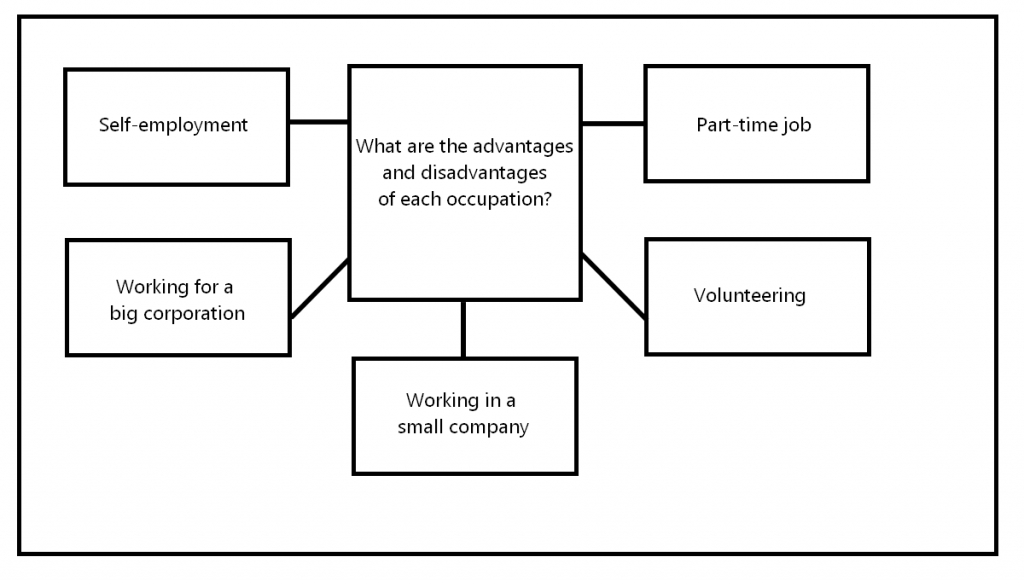
Now, talk to each other about the advantages and disadvantages of each of these occupations.
Sample answer
Candidate A (Boris): Do you mind if I go first?
Candidate B (Ira): Sure, go ahead.
Boris: I believe that a part-time job offers a serious advantage of giving you more free time and flexibility to do something else while allowing to make enough money for a living.
Ira: It might be so, but are you sure working part-time will be enough to cover anything but one’s living expenses like bills and groceries? I really doubt it, to be honest.. I think working in a smaller company offers similar advantages to the ones you’ve mentioned, but the money must be better since you’ll be putting in more working hours.
Boris: I guess you are right. And the smaller companies are usually willing to give you more leeway with your schedule and your decisions. However, smaller businesses tend to go under quite often, so there’s very little in terms of job security. But what about self-employment? On paper, it should give you all the freedom you wish for, being your own boss and all!
Ira: Oh, I’m not so sure about that. You’ve brought up financial security, and working for yourself is such a dangerous venture! If stability is something you prioritise, that is probably not your best option. It does sound lucrative though – you earn as much as you make, there is nobody to order you around. It sounds so invigorating!
Examiner: Thank you. Now you have about a minute to decide which occupation is most stressful.
Ira: Being self-employed is likely to be the most taxing one emotionally, I mean you have the weight of the decision on your shoulders, everything depends on you, all this has to really taken its toll emotionally, wouldn’t you agree?
Boris: To be honest, at first I was thinking about working for a major company, but you do have a point and you’ve managed to convince me. In the light of your arguments mine seem to be irrelevant, I won’t even bother with them.
Another example
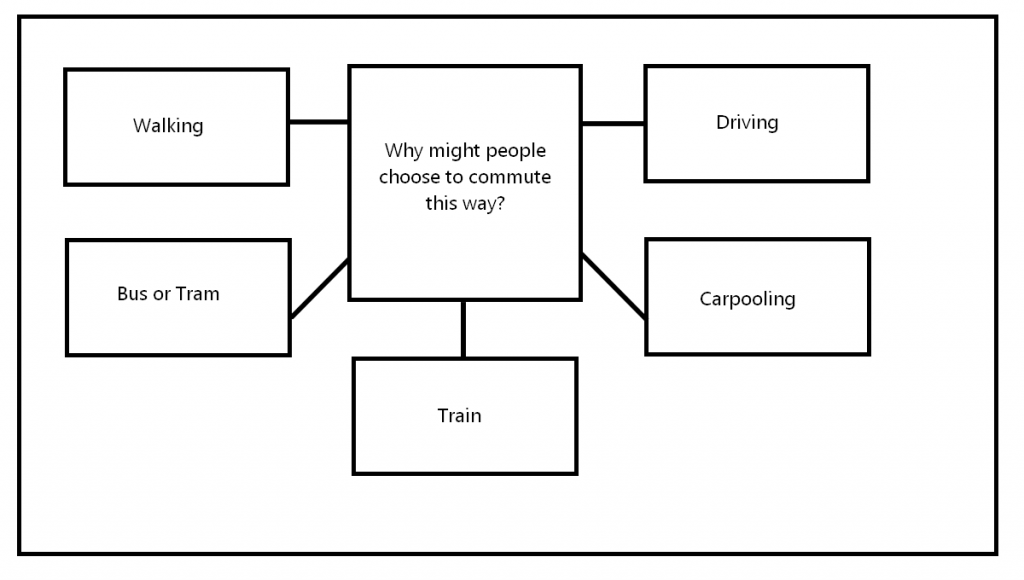
Extra question: which way of commuting might be most popular in rural areas?
Speaking Part 3 Useful Phrases
| Walking | Bus or tram | Train | Driving | Carpooling |
|---|---|---|---|---|
| – Walking is free – or almost free. All you need is a pair of comfortable shoes – Walking to work or place of study takes exactly the same amount of time as you are not dependant on traffic congestion. This makes it more reliable – It is a nice, gentle form of exercising | – Commuting by bus or tram is quick and affordable – Bus lanes make getting somewhere quick even during rush hour – Using public transport shows environmental awareness and that you care about the planet – You can read or listen to the music en route | – Trains never suffer from traffic congestion, although they might be overcrowded during peak times – Trains always run on schedule so you can plan your day more effectively and reliably – Arguably, trains can be more comfortable than cars and buses as they maintain constant speed throughout the way without having to accelerate or slow down | – Probably one of the most expensive ways to commute, driving offers unmatched personal freedom – It is most convenient for big families with kids as they have to be taken to places like school or kindergarten – Some people find the process of driving a car enjoyable in itself, without going somewhere in particular | – Affordable and environmentally friendly – Carpooling encourages socialising and bonding with your colleagues/fellow students – Both driver and the passengers benefit if they chip in to pay for fuel – Makes the commute more fun when there are more people in the car |
Part 3 tips and useful phrases
These are the three important aspects of Part 3:
1 – Starting the dialogue
2 – Connecting and transitioning the ideas
3 – Reaching an agreement
1. Starting the dialogue
At the beginning of Part 3 you have to decide who will begin the conversation. It is important to be respectful and give your partner room choice. You can either initiate this yourself of wait for your partner to go first. Here are some phrases for both:
| Starting the dialogue | Responding |
|---|---|
| Do you mind if I go first? Would you mind going first/starting? Care to go first? Should I begin, or would you like to go first? Would it be okay with you if I started this? Is it okay for you if I start? | Yeah, sure, go ahead. Okay, I will! I’d rather you went first, if that’s okay with you. By all means, go ahead. Sure, not a problem |
The responses do not necessarily have to be linked to the corresponding question, so feel free to mix and match them. A good idea is to let the initiator go first, but ultimately it is up to you.
2. Connecting the ideas
A common mistake in Part 3 is to simply wait for your turn to speak, without paying attention to your partner’s response. This is going to bring your mark down! Instead, you want to implement ideas from your partner’s answer into your own. It’s important to transition the ideas smoothly – your exchange should look like a dialogue, not a series of isolated sentences! Here are some ways to make your speech more cohesive:
3. Reaching an agreement
In the second half of Part 3 you have to agree upon one or two aspects of the mind-map. If you fail to agree on one, it is okay to respectfully disagree. Here are some useful phrases for suggesting, encouraging a conversation, agreeing and disagreeing:
| Agreeing | Disagreeing (politely) |
|---|---|
| I totally agree with your point… I’m with you on that one… Your arguments are very compelling I had a different idea, but your arguments sound very convincing Your points are very persuasive, and I side with you on that one | I see what you mean, however… You make some valid points, but let’s consider… With all due respect, I can’t agree/I have to disagree Your logic here is flawless, but another point to consider is… |


No hay comentarios:
Publicar un comentario